
Tree Removal in Chardon, OH: Which Trees Come Down, and How
Short answer
Tree removal in Chardon, Ohio makes sense when a tree is dead (very often an ash killed by emerald ash borer), split at a fork, rotting at the base, or leaning harder toward the house after a soaking and a hard wind. For a tree on your own house lot, nothing we read in the city's code calls for a removal permit; trees on the tree lawn by the street are different, because the city's Shade Tree Commission looks after those (City of Chardon, checked Nov 18, 2026) and the code bars removing one without the City Arborist's or City Manager's approval (Sec. 909.06, checked Nov 18, 2026).
Below: the signs worth acting on, how a crew takes a tree apart near a house, what Chardon's ground and weather add to the job, and what to settle in writing before the first cut.
Signs a Chardon yard tree has run out of time
A big tree near a house isn't a problem just for being big. Sugar maples, red oaks and black cherries are native to the till soils around here and can stand for a century. The ones worth a closer look usually show one of these:
- A dead or dying ash. The Ohio forest health report says "significant mortality of ash is now occurring throughout Ohio" (Ohio Forest Health Highlights 2022, checked Nov 18, 2026). A bare top, bark sloughing off in plates, and heavy woodpecker work are common clues. Exposed ash wood has little to no resistance to decay, and borer-killed ash keeps breaking apart or toppling over for years; see the ash and beech page.
- A beech with dark stripes between the leaf veins. That banding is the early sign of beech leaf disease, which was first found next door in Lake County in 2012. Young beeches can die from it within a few years.
- Fungus, cavities or soft wood at the base. Mushrooms or shelf fungi on the root flare, a hollow you can push a stick into, or wood that crumbles mean decay where the tree carries its weight.
- A lean that is new or getting worse. A tree that has always leaned is one thing. A tree that tilted after the ground thawed or a storm passed, with soil cracked or mounded on the far side, is pulling its roots out.
- A crack through a fork. Two trunks joined in a tight V often split under snow or ice. A crack running down from the union is a warning, not a cosmetic flaw.
- Roots cut for a driveway, a drain or an addition. Chardon's own subdivision rules tell developers not to change the grade under a tree's crown (Sec. 1165.03(e)), which says something about how roots react to it.
Unsure? Put that in the request. Whether a tree can stay is a fair question for the contractor to answer after seeing it.
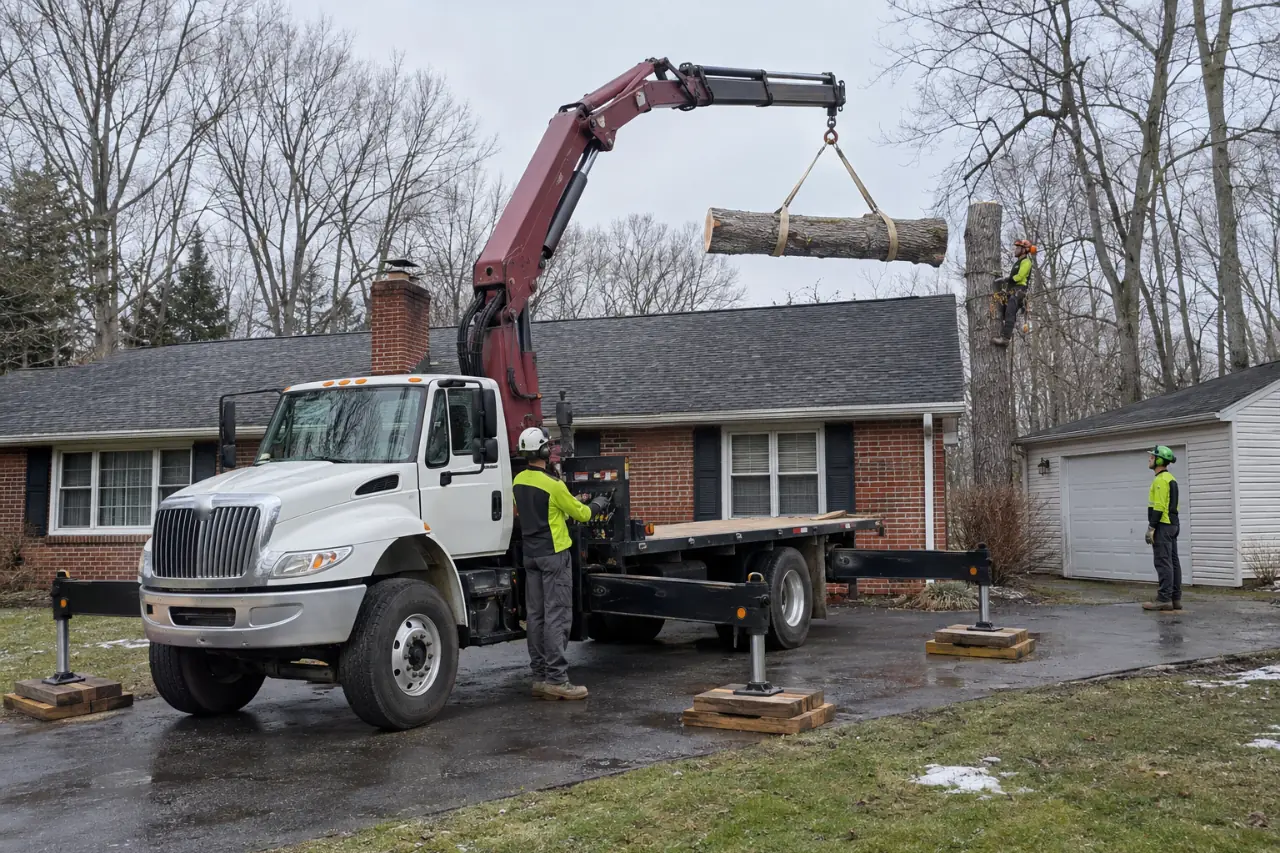
Taking a tree down in pieces beside a house
Only a tree with open ground around it gets dropped in one piece. Near a roof, a garage, a fence or the service wire, the usual sequence goes like this:
- Look the tree over and plan the drop zone. The crew picks where pieces will land, where the chipper and truck will sit, and how ropes will run.
- Climb or lift up to the crown. A climber ties in to a strong part of the tree, or an aerial lift reaches it if a truck can get close without sinking.
- Remove the limbs from the top down. Each limb is cut and either dropped into the clear area or lowered on a rope through a friction device anchored low on the trunk, so no branch over the roof drops uncontrolled.
- Bring down the trunk in sections. Rounds are cut short enough to handle and lowered or dropped onto the ground or onto mats.
- Cut the stump low. Grinding is a separate step and usually a separate line on the quote.
- Clean up. Brush goes through the chipper; the wood is hauled or stacked depending on what you agreed.
For a very large tree leaning over a house, some crews bring a crane so each section is lifted away rather than lowered. That costs more for the day but can be the safer way to handle a tree that can't take a climber's weight.
What Chardon's ground and weather add to the job
Soft, wet till. Much of Geauga County is glacial till that drains slowly. The USDA describes the Darien soil, mapped in Geauga County, as somewhat poorly drained silt loam (USDA soil series, checked Nov 18, 2026). In spring and late fall a loaded truck can rut a lawn badly. Ask how the crew plans to get equipment in: ground mats, a smaller machine, or a wait for drier or frozen ground.
Snow on the ground. Chardon has averaged a little over 105 inches of snow a season in the city's record since 1952–53, and it got 117.3 inches in 2025–26 (City of Chardon snowfall table, checked Nov 18, 2026). Deep snow hides stumps, tools and dropped limbs, and it slows cleanup. A tree that can wait is often easier to remove before the first big lake-effect band or after the thaw.
Ravines and creek banks. Some lots fall away to small streams. Bringing pieces up a steep bank takes ropes, more people and more time than a flat yard.
The wire to your house. If the tree touches or overhangs the service line, the crew may need the Illuminating Company to disconnect it during the work. FirstEnergy offers that for a nominal fee with several business days' notice (FirstEnergy, checked Nov 18, 2026). More on the power lines page.
Who keeps the wood, and where the brush goes
You can't burn the brush inside Chardon. The city is a municipal corporation, and Ohio EPA rules ban open burning of waste in municipal limits; small recreational fires of clean firewood are the narrow exception (Ohio Adm. Code 3745-19-03, checked Nov 18, 2026). Ohio EPA's guide also says a tree removal contractor may not haul limbs to another site to burn them.
That leaves three options, and the quote should say which one you're getting:
- Full haul-off. Brush chipped into the truck, logs loaded and taken away.
- Chips and rounds left. Some owners keep the chips for beds and the rounds for splitting. Maple, oak and cherry are prized for firewood; dead ash burns well too.
- Brush hauled, logs left. A middle ground when you want the wood but not the mess.
Don't count on curbside pickup for a whole tree. The city's Street Department page lists fall leaf collection, not tree debris (City of Chardon, checked Nov 18, 2026), and the 2026 recycling calendar lists yard waste and wood among the things that don't belong in the recycling.
Settle these before the first cut
- Exactly which trees. Point to each one together, and mark them if there are several. "The dead ash by the shed" is clearer than "the back trees."
- Stump height and grinding. Flush cut, a few inches left, or ground below grade.
- The wood and the brush. Hauled, chipped and left, or stacked.
- The lawn and driveway. Mats, plywood, or a note that ruts get raked and seeded.
- A tree near the lot line. Under Ohio law a tree that stands on the boundary belongs to both neighbors, and one can't take it down without the other's agreement (OSU Agricultural & Resource Law Program, checked Nov 18, 2026). Recklessly cutting a tree on someone else's land can bring treble damages under Ohio Revised Code 901.51. Settle where the line is first.
- Utility and 811 calls. Who arranges a disconnect, and who calls OHIO811 if grinding is part of the job.
Written contracts and deposits are covered on the who does tree work page.
When taking the whole tree isn't the answer
A sound oak with one dead limb over the driveway needs trimming, not removal. A maple that lost a branch to wet snow but has a solid trunk and a full crown may only need the break cleaned up. If the worry is mostly about winter loads, start with the trimming page. And if the tree is on the tree lawn, the decision belongs to the city, not to you or a contractor; see Chardon's tree rules.
Asked about removals in Chardon
Is winter a bad time to take a tree down here?
Not necessarily. Frozen ground can carry equipment that would sink in April. Deep snow and short days slow the work, though, and storm weeks keep crews busy with emergencies.
The tree fell into my yard from next door. Whose job is it?
Ohio State's agricultural law program says each landowner generally cleans up the debris on their own property, and a neighbor is usually liable only if they knew the tree was diseased, weak or plainly dangerous. Call your homeowner's insurer first if it damaged something.
How long does a removal take?
A small open-yard tree can be a short visit. A large tree over a roof, with rigging and cleanup, can take most of a day or longer. The contractor can tell you once they've seen it.
Other pages for Chardon tree owners
Got a tree that worries you?
Call or use the form. Your request goes to one independent contractor working in Chardon and the Geauga County townships around it, who comes out, looks at the tree, quotes the work and does it.