
Ash and Beech Tree Removal in Chardon, OH: Borers and Leaf Disease
Short answer
Ash and beech tree removal in Chardon, Ohio usually traces back to pests and disease. Emerald ash borer has been confirmed in every Ohio county and ash is dying throughout the state, and a dead ash near a house, driveway or wire should come down sooner rather than later, because exposed ash wood has little to no resistance to decay and borer-killed trees keep breaking apart and toppling for years after they die. Beech trees have their own problems here: beech leaf disease was first discovered in neighboring Lake County in 2012, and the scale insect behind beech bark disease was first found in Ohio at the Holden Arboretum, which the state's forest health report places in Lake and Geauga Counties (sources below, checked Nov 18, 2026).
Emerald ash borer in Geauga County yards
Ohio's first confirmed emerald ash borer turned up in Lucas County, around Toledo, in February 2003 (Ohio Forest Health Highlights 2007). By 2022, the state's forest health report called the borer "the most devastating forest pest in Ohio in recent years," noted that all 88 counties had confirmed infestations as of 2016, and said plainly that "significant mortality of ash is now occurring throughout Ohio" (Ohio Forest Health Highlights 2022, checked Nov 18, 2026). Ash was a common yard and woodlot tree in northeast Ohio; the USDA lists it among the native trees on the region's till soils (USDA Platea series).
Signs an ash is going or gone, as seen from the ground:
- The crown thins from the top down, with bare twigs above and leaves only lower.
- Patches of bark flake off, often where woodpeckers have worked the trunk for larvae.
- Bunches of sprouts appear low on the trunk or at the base.
- No leaves at all in June, when the maples around it are full.
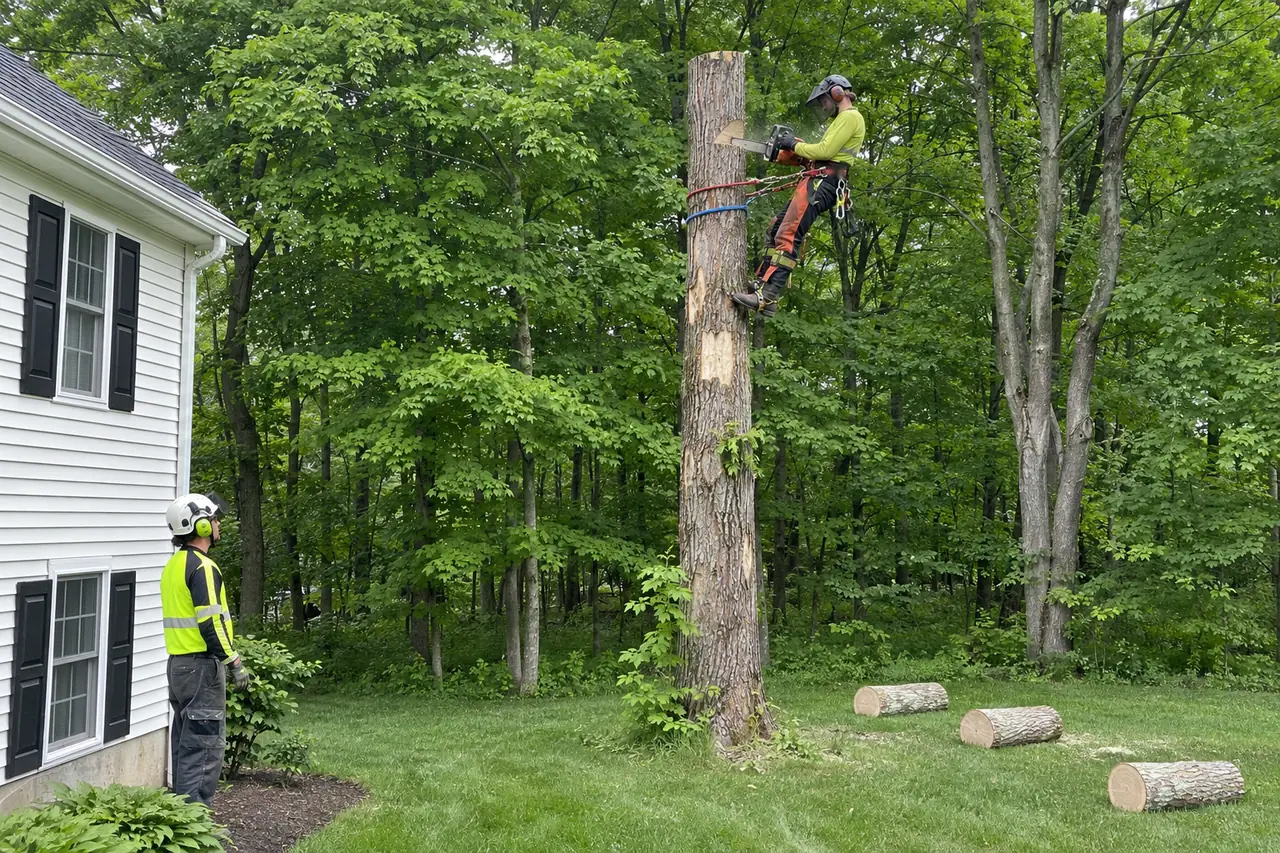
Why a dead ash gets riskier every season
Joe Boggs of Ohio State University Extension wrote that ash wood "has little to no resistance to decay if exposed to the elements," and described borer-killed ash, dead for a number of years, still breaking apart or toppling over as wood-rotting fungi weakened the trunks. Taking down unstable dead trees, he warned, "is not a job for the faint of heart; inexperience can kill" (OSU Buckeye Yard & Garden onLine, Mar 19, 2019, checked Nov 18, 2026).
That has three practical results for a Chardon homeowner:
- Snow and wind find dead ash first. A brittle crown that would have flexed when alive snaps under a lake-effect load or a 60 mph gust like the ones in the March 13, 2026 windstorm.
- The job gets harder the longer it waits. A climber can tie into a tree that died last year. A tree that has rotted for several winters may not hold a climber's weight, so the crew needs a lift or a crane to take it apart from outside, and that costs more.
- Falling pieces aren't predictable. Dead limbs can let go when the trunk is cut or even bumped. Keep kids, pets and cars clear on removal day.
An ash that's dead and standing well away from anything, at the back of a wooded lot, can be left as wildlife habitat if you're comfortable with that. One that can reach the house, a drive, a play area or the road is the one to deal with first.
Beech leaf disease: dark bands between the veins
A 2019 pest alert from the USDA Forest Service, the Ohio Department of Natural Resources, Cleveland Metroparks and Lake Metroparks says "BLD was initially discovered in Lake County, Ohio in 2012" (Beech Leaf Disease Pest Alert, Nov 2019, checked Nov 18, 2026). What to look for:
- Dark green stripes between the side veins of the leaves, easiest to see standing under the tree and looking up.
- Leaves that turn thick and leathery, often with shriveled or curled edges.
- Fewer leaves as buds abort, so the crown thins year after year.
The alert reports an association with a foliar nematode, Litylenchus crenatae, though it says the cause had yet to be officially identified, and notes that saplings have died within two to five years. A later update from ODNR's forest health program manager reported symptoms in 25 Ohio counties and said "tree mortality of all age classes has been observed occasionally within 2 to 7 years" (OSU Buckeye Yard & Garden onLine, June 20, 2023). If you think a beech has it, the update suggests contacting your county Extension office or an ODNR service or urban forester, or reporting it through the Tree Health Survey app.
Beech bark disease and the Holden Arboretum find
The insect half of beech bark disease, a scale insect, "was first discovered in Ohio in 1985 at the Holden Arboretum in Lake and Geauga Counties," and the fungus that finishes the job was confirmed there in December 2003 (Ohio Forest Health Highlights 2007, checked Nov 18, 2026). By 2007, the report said, the scale was "still easily found" in several northeast Ohio counties, Geauga among them. The scale shows up as patches of white, woolly wax on the bark.
A beech carrying both diseases has two strikes against it. If it leans over the house, get it looked at.
Other tree pests on the Geauga County list
- Hemlock woolly adelgid. Two infested hemlocks were destroyed at a Geauga County site in 2004 (Ohio Forest Health Highlights 2007), and the pest was confirmed in 20 Ohio counties by 2022 (Ohio Forest Health Highlights 2022, checked Nov 18, 2026). Hemlock is among the native trees the USDA lists for the Darien soil, which is mapped in Geauga County; look for white, cottony tufts at the base of the needles.
- Oak wilt. The 2022 report noted "a concerning increase in oak wilt infected areas since 2019." OSU's advice is no oak pruning from April 15 to October 15.
- Spotted lanternfly. The Ohio Department of Agriculture put all of Ohio under a spotted lanternfly quarantine effective Feb. 17, 2026, replacing a quarantine that had covered 18 counties; its main host is the invasive tree of heaven (OSU Buckeye Yard & Garden onLine, checked Nov 18, 2026).
Remove, keep an eye on it, or ask for treatment?
| What you see | Usual next step |
|---|---|
| Dead ash within reach of the house, a drive, a wire or the road | Removal, the sooner the better |
| Dead ash deep in the woods, nothing nearby | Can stand, if you accept it will fall someday |
| Ash still fully leafed out, no bark damage | Ask the contractor whether protecting it still makes sense for that tree |
| Beech with banded leaves but a full crown | Watch it each summer and report it |
| Beech with a thin crown, dead limbs, or cracked and bleeding bark, near a target | Have it inspected for removal |
| Oak with sudden leaf browning in summer | Call soon, and don't prune it in the meantime |
Ash and beech questions from around Chardon
Can I burn the ash wood?
Not in an open pile inside Chardon; Ohio EPA rules bar open burning of waste within city limits. Split and seasoned, ash is ordinary firewood for a stove or fireplace.
Will cutting down a sick beech spread the disease to my other beeches?
None of the sources above say that removing a beech spreads the disease, and the 2019 alert noted the cause had not yet been officially identified. Removal is about the safety of that one tree.
My ash is on the tree lawn. Do I call a contractor?
No. Tree-lawn trees are the city's; report it under Chardon's tree rules.
See also
Got a tree that worries you?
Call or use the form. Your request goes to one independent contractor working in Chardon and the Geauga County townships around it, who comes out, looks at the tree, quotes the work and does it.